
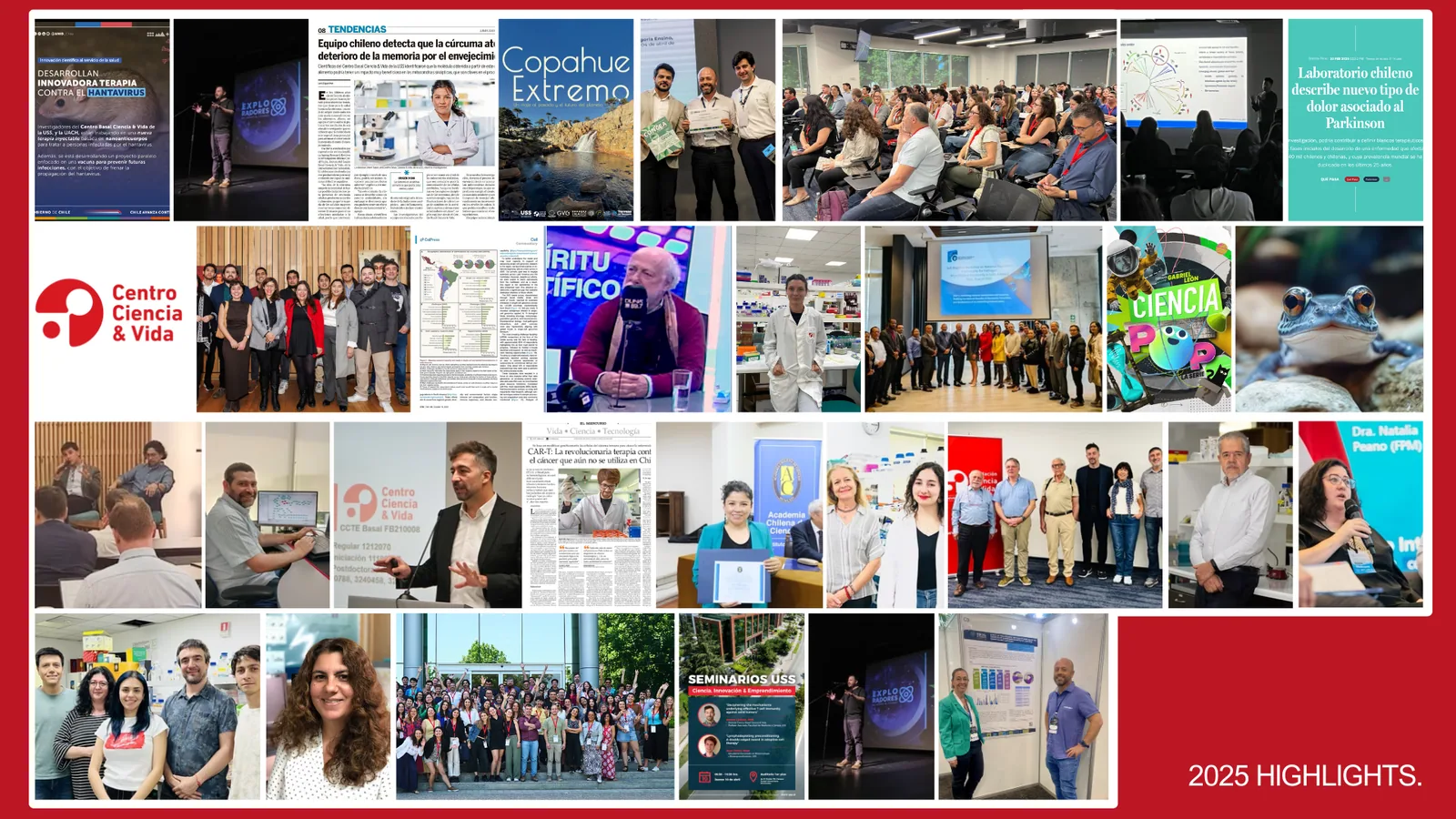
During 2025, the Centro Ciencia & Vida, of the Fundación Ciencia & Vida | Universidad San Sebastián, experienced a year of institutional consolidation, marked by a clear sign of continuity and projection: the renewal of its scientific leadership.
During 2025, Centro Ciencia & Vida, of the Fundación Ciencia & Vida | Universidad San Sebastián, experienced a year of institutional consolidation, marked by a clear signal of continuity and projection: the renewal of its scientific leadership .
With Dr. Álvaro Lladser assuming the role of director and Dr. Raquel Quatrini as alternate director, the Basal Center opened a new stage, focused on strengthening its national and international presence, as well as deepening a way of working that is already part of its hallmark: articulating frontier research with impact on society.
This momentum unfolded throughout the year in milestones across the Center's five research clusters, showing how diverse lines—from immunology and emerging viruses to cancer, neuroscience, and computational modeling—dialogue with each other to answer complex questions and the country's challenges.
In Cluster I, Immune Intervention and Inflammation , 2025 was marked by the strengthening of scientific work through competitive grants , such as Dr. Rodrigo's project analyzing the role of the short-chain fatty acid receptor GPR43 in the interaction between T cells and the microbiota in Parkinson's disease. Thus, Parkinson's established itself strongly on the Center's public agenda, highlighting the vocation to connect biomedical evidence with the social conversation on chronic diseases, early diagnosis, and treatment routes . The projects obtained by the Center's researchers reinforced lines in immunology , such as the one led by Dr. María Rosa Bono's laboratory, and neurosciences, ensuring continuity for translational studies. Along with this, we also learned more about Dr. Mario Rosemblatt's scientific career in a revealing radio interview .
In Cluster II, Viruses, Microbes and Infections , science directly met public policy. Researchers from the Basal Center presented before the Future Commission of the Chamber of Deputies on advances in the design of vaccines and therapies against the Andes virus (hantavirus) , highlighting both the risk of contagion and the need for preparedness and the challenge of scaling these developments to clinical standards. It was a milestone that portrays the Center not only as a generator of knowledge but also as an actor providing evidence for strategic decisions against infectious threats.
In Cluster III, Cell Regulation and Tumor Biology , the year combined high-impact results with an intense international agenda. On one hand, an experimental strategy against glioblastoma was disclosed, seeking to reverse resistance to immunotherapy by eliminating regulatory T cells, in an international collaborative work with the Center's participation and publication in a leading journal in the field. On the other hand, Dr. Lladser's European tour , with his participation in IUIS 2025 and meetings with institutions of excellence such as i3S, UCL, Oxford, Institut Curie, and Institut Cochin, consolidated networks and opened concrete opportunities for collaboration and advanced training. For its part, the laboratory led by Dr. Alejandra Loyola celebrated the doctoral degree obtained by one of its students within the framework of the USS Doctorate in Biotechnology and Bioentrepreneurship. Additionally, Dr. Alfonso González stood out as part of the CCV 2025 seminar series, with a talk on endocytic trafficking as a potential therapeutic target in cancer.
Cluster IV, Cell Signaling and Neuropathology , also added powerful milestones with high translational potential , such as the work of Dr. Enrique Brandan who detected a pathway called YAP/TAZ, whose inhibition manages to decrease the fibrotic response. At the same time, the year stood out for recognitions of scientific careers: Dr. Cheril Tapia received the “Outstanding Young Scientist 2025” award from the Biology Society of Chile and GrupoBios , as well as the “Adelina Gutiérrez” Award for Scientific Excellence from the Chilean Academy of Sciences , bringing to the forefront her work in the neurobiology of aging developed in Chile. Similarly, the work directed by Dr. Soledad Matus with an undergraduate student achieved recognition and was highlighted at the national level. For its part, research on tissue regeneration, supported by models such as Xenopus laevis , captured attention for the possibilities it opens toward future therapies for spinal cord injuries and degenerative diseases, reinforcing the Center's positioning in neuroscience.
In Cluster V, Modeling and Computational Biology , consolidation came through infrastructure, capabilities, and new approachable questions . The Center's integration into the national SCAI-Lab project —supercomputing infrastructure aimed at boosting R&D in artificial intelligence—strengthened tools for data science applied to biomedical and biotechnological problems. In the same vein, works were deployed where AI and supercomputing expand the scope of scientific analysis, for example in cancer and aging, or with new publications led by Dr. Tomás Pérez-Acle . A milestone was also marked in computational virology, with structural modeling applied to the study of a porcine virus and its possible biotechnological uses , showing how problems previously unapproachable due to data volume and complexity are now transformed into a fertile field of research.
Viewed as a whole, during 2025, Centro Ciencia & Vida consolidated its leadership and networks, communicating competitive and high-impact results, in addition to reinforcing its capacity to translate frontier science into public conversation. It operates by clusters but thinks as a system: connecting disciplines, scales, and audiences to sustain research of excellence with national and global projection.
But the year was not just about papers, models, and experimental results. In Outreach, the Center once again demonstrated that communicating science is about building narratives capable of reaching far without losing rigor. Two milestones concentrated this ambition. The first was the documentary “Copahue Extremo: A journey to the past and future of the planet,” produced by the Eureka Program and led by Dr. Raquel Quatrini , which invited the public on an expedition to the Copahue volcano to explore extremophile microorganisms, the clues they provide about the origin of life, and their potential applications in biotechnology and green mining. The second was the tenth season of “Exploradores del átomo al cosmos,” celebrating a decade of journey and connecting millions of viewers with cutting-edge research made in Chile.
In Entrepreneurship, 2025 showed how knowledge is not only produced: it is also formed, accelerated, and transferred . In addition to the progress of the spin-off Immuno Connect as a case of transfer from the laboratory to biomedical solutions, the Center boosted the educational dimension of the entrepreneurial ecosystem by being awarded, together with CeBiB and Grupo Zenit, a CORFO Viraliza fund for the training of STEM female entrepreneurs, with workshops, mentoring, and support networks, projecting to train 40 women in 12 to 18 months. Along with this, the Business and Intellectual Property and Technology Transfer directorates, led by Constanza Sigala and Álvaro Martínez, respectively, had outstanding participations in the local biotechnological entrepreneurship ecosystem.
In Global Science, an institutional milestone of great strategic value was the agreement between Centro Ciencia & Vida and the i3S of the University of Porto . Designed to integrate competencies and face global challenges in health and biotechnology, the agreement opens doors to joint research, academic innovation, collaborative programs (including the possibility of double degrees), exchange of human capital, and the organization of scientific meetings. Alliances like this do not just expand networks: they accelerate mobility, shared funding opportunities, and the circulation of knowledge.
Finally, Advanced Training confirmed a key idea: training human capital is not an appendix to research, but its condition for continuity . Achievements in professionalization were highlighted— such as the international certification in Biological Risk Management (IFBA) obtained by Dr. Nicole Tischler , strengthening regional capacities in biosafety and bioprotection —as well as recognition for new generations, such as the 2025 SBCCH Best Undergraduate Thesis Award for Sofía Parham Jadue, from the Biology of Neurodegeneration laboratory, for her work on the GCN2 kinase and cellular adaptation with sex-dependent findings .
Added to this was professional updating in applied fields, from awards and international academic participation of the Center's Veterinary Area to instances of regional training in animal welfare and ethical research . Additionally, we celebrate the investiture of new doctors emerging from the doctoral programs promoted by the Center alongside Universidad San Sebastián .
In summary, 2025 was a year in which Centro Ciencia & Vida sustained and made visible a core idea: scientific excellence grows when it connects. It connects disciplines—from computing to the laboratory—, connects scales—from microbial communities to strategic decisions—, connects territories—from the Copahue Volcano to international networks—and connects audiences—from specialized journals to documentaries and television. This combination of robust clusters and active pillars is, precisely, the hallmark of a 360 Science in action for almost 30 years now.