
Through a collaboration agreement, both institutions are advancing projects that integrate fundamental research with clinical expertise and access to patient samples, aiming to deepen the understanding of cancer and contribute to the development of new therapeutic strategies.
The collaboration between Centro Ciencia & Vida (FCV-USS) and Fundación Arturo López Pérez (FALP) seeks to strengthen the ties between scientific research and clinical practice, promoting studies that address relevant questions for cancer diagnosis and treatment.
This alliance takes on special significance within the framework of the first anniversary of the Center for Cancer Research and Innovation (CIIC) of FALP, an institution that during its first year of operation has reported over 113 scientific publications and maintains more than 230 active research projects. These achievements are complemented by its accreditation as a Comprehensive Cancer Center, the highest category granted by the Organisation of European Cancer Institutes (OECI), making it the first institution outside of Europe to earn this recognition.
In this context, the agreement between FALP and Centro Ciencia & Vida integrates scientific and clinical capabilities, leveraging our center's over 30-year track record in fundamental research—backed by ANID basal funding until 2031—alongside FALP's expertise in specialized oncological patient care.
"The agreement involves developing at least five joint projects," explains Dr. Alvaro Lladser, director of Centro Ciencia & Vida, associate professor at Universidad San Sebastián, and director of the Immunooncology Laboratory. "These studies are led by our researchers, with access to the clinical team and samples from Fundación Arturo López Pérez (FALP)."
Research oriented toward clinical needs
One of the main contributions of this collaboration is the ability to guide new research questions based on the challenges faced by medical teams in patient care.
"For us, this alliance allows us to direct our research to answer questions that have not yet been covered and that are relevant to physicians and patients," Lladser emphasizes.
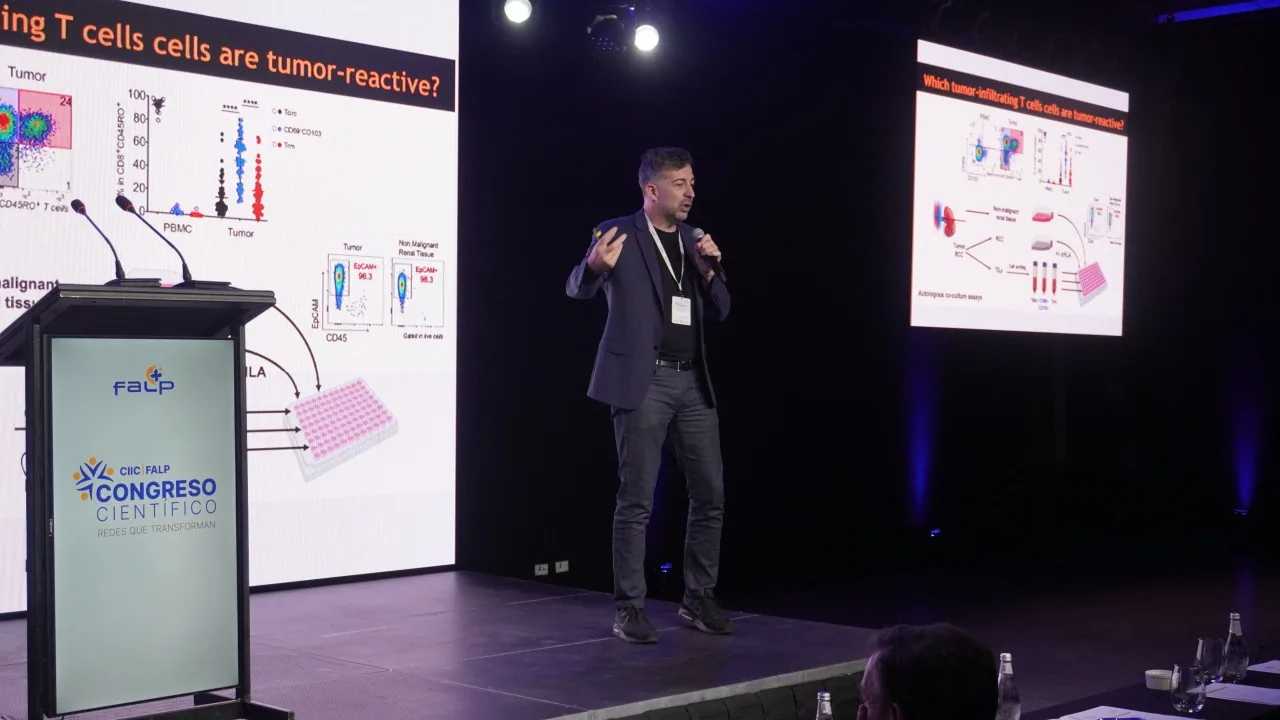
An example of this work relates to the study of T lymphocytes, immune system cells that play a fundamental role in the body's response against cancer.
Specifically, researchers at Centro Ciencia & Vida are studying how these cells infiltrate renal tumors and participate in the elimination of cancer cells. However, the collaboration with FALP has helped identify new questions linked to the clinical evolution of patients.
"We are studying T lymphocytes, which are white blood cells responsible for killing cells. And in renal cancer, we investigate how these T lymphocytes enter the tumor and attack cancer cells. But for most patients, as we have seen at FALP, the tumor is removed; therefore, the most relevant question in clinical terms would be to study the T lymphocytes that remain circulating after surgery, and what their role is in recovery, rather than those residing in the primary tumor," the researcher explains.
This approach complements laboratory studies with questions arising from clinical experience, fostering research that is more closely connected to patient needs.
Strengthening ties between science and medicine
The alliance also represents an opportunity to strengthen the articulation between fundamental research and the clinical field in Chile, an essential connection to advance the development of new diagnostic and therapeutic tools.
As Lladser explains, this approach allows medical needs to guide scientific questions—a model known as research pull—where challenges arising from clinical practice help define new lines of research.
"We are a research center, associated with Universidad San Sebastián, but we are not embedded in a clinical setting. That is why our alliance, as well as the creation of the CIIC at Fundación Arturo López Pérez (FALP), is fundamental. It is what I experienced when I did my postdoctoral fellowship at Karolinska in Sweden. This bond is finally being created; it is very virtuous and is going to do very well," points out the director of Centro Ciencia & Vida (FCV-USS).
This collaboration reaffirms Centro Ciencia & Vida's commitment to excellence in research that is collaborative and connected to health challenges, strengthening national capabilities to advance cancer knowledge and contribute, in the long term, to the development of better treatment alternatives for patients.
***
Original text by Evelyn Silva-Moreno, Research and Innovation Manager at FALP.