
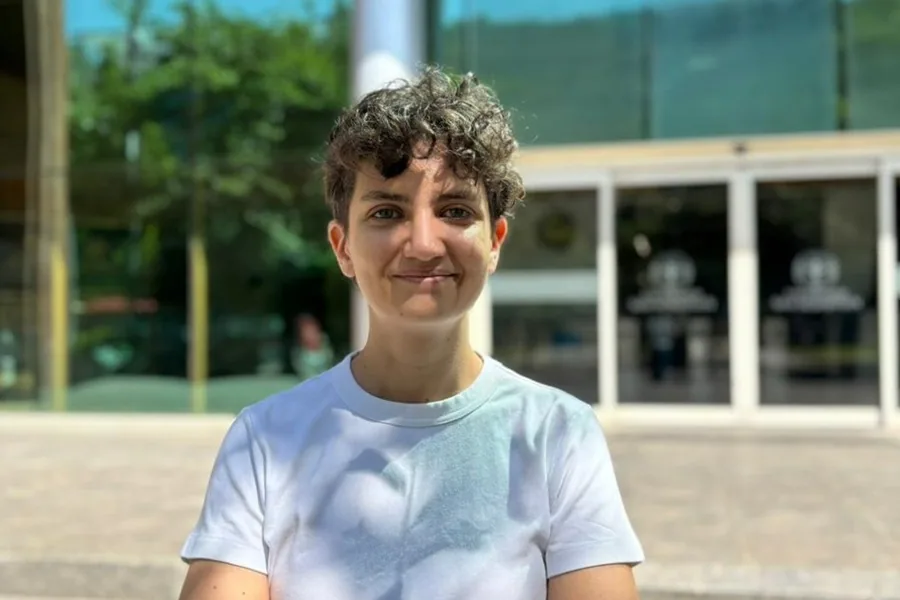
Madeleine Fatio, a Biomedical Sciences student at the University of Fribourg, Switzerland, completed a research internship in Dr. Hugo González’s laboratory at Centro Ciencia & Vida, joining a team devoted to the study of cancer and strengthening international academic exchange.
Madeleine Fatio, a Biomedical Sciences student at the University of Fribourg, Switzerland, completed a research internship in Dr. Hugo González’s laboratory, joining a team devoted to the study of cancer and strengthening international academic exchange.
Madeleine Fatio, an undergraduate student in Biomedical Sciences at the Université de Fribourg, Switzerland, completed a five-month research internship in a laboratory of the Ciencia & Vida Basal Center , of Fundación Ciencia & Vida and Universidad San Sebastián (USS).
The internship, in the second half of 2025, was supervised by Dr. Hugo González, academic at the USS Faculty of Health Care Sciences and director of the Tumour Microenvironment and Metastasis Laboratory at Centro Ciencia & Vida, with the aim of gaining advanced experimental training in biomedical research, particularly in the study of metastatic disease.
The collaboration arose from the student’s own wish to do an internship in Chile: her mother is Chilean and she wanted to experience life in her mother’s home country. She contacted the team from Switzerland in search of training in experimental research. “We work on cancer and her profile fitted very well with what we do. After the interview, the process was quite natural,” said Dr. González.
From an academic perspective, the researcher noted that welcoming international students reflects the laboratory’s commitment to training. “Beyond producing research, here we train people. We want to contribute to the training of future scientists and, at the same time, benefit from the international perspective they bring, especially from countries with more developed scientific ecosystems,” he said.
Research, training and international experience
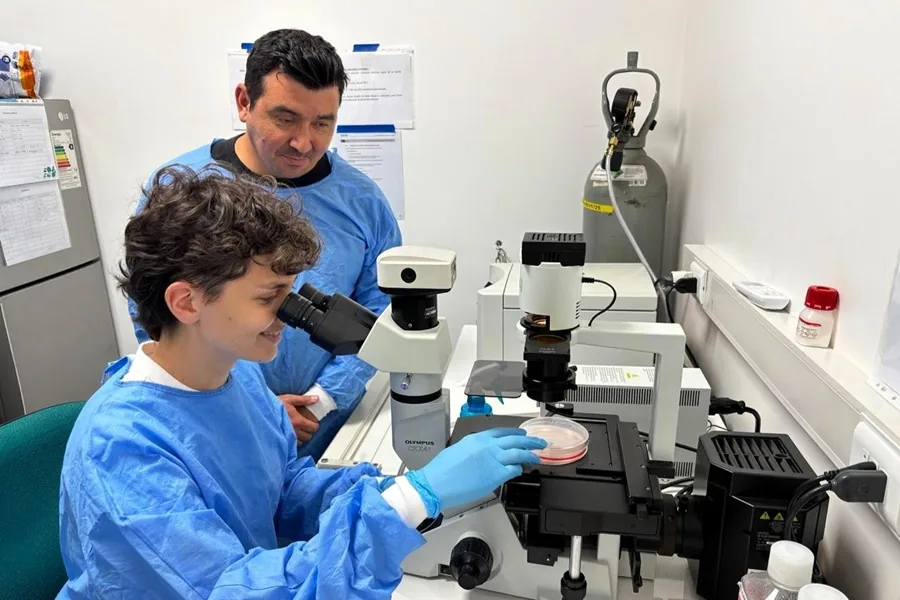
During her stay in Dr. Hugo González’s laboratory at Centro Ciencia & Vida, Madeleine Fatio took an active part in the laboratory’s daily work, supporting cell-culture experiments and taking part in molecular biology, histology and bioinformatic data analysis techniques. Her training focused on handling cell lines and understanding the biological processes involved in metastasis, one of the main causes of cancer deaths worldwide.
“I spent much of my time on cell culture, preparing and maintaining cells for the experiments, but I was also able to learn techniques such as PCR, data analysis and some histology. It was a very complete and demanding experience,” explained the student, who is studying for an undergraduate degree in Biomedical Sciences, a programme that combines training in biology and medicine.
High-level learning
The student particularly valued the academic environment and the level of the scientific work in the Basal Center laboratory. “I felt very welcome in the team. The atmosphere is calm and respectful, which makes learning much easier. In terms of level, what I have seen here is quite similar to what I know from Switzerland, apart from some differences in equipment,” she said.
After completing her internship, Madeleine returned to Fribourg to finish her studies. In the Swiss system, university training comprises the bachelor’s and master’s cycles; she now aims to complete her master’s and later pursue an academic career.
Original USS article (in Spanish).