
The outstanding biochemist was recognized for her thesis work to obtain her professional degree in biochemistry from the Universidad de Chile. Her work focuses on the GCN2 kinase and its role in cellular adaptation, a pioneering study revealing sex-dependent differences in the response to amino acid scarcity.
Sofía Parham Jadie was recognized for her thesis work to obtain her professional degree in biochemistry from the Universidad de Chile. Her work focuses on the GCN2 kinase and its role in cellular adaptation, a pioneering study revealing sex-dependent differences in the response to amino acid scarcity.
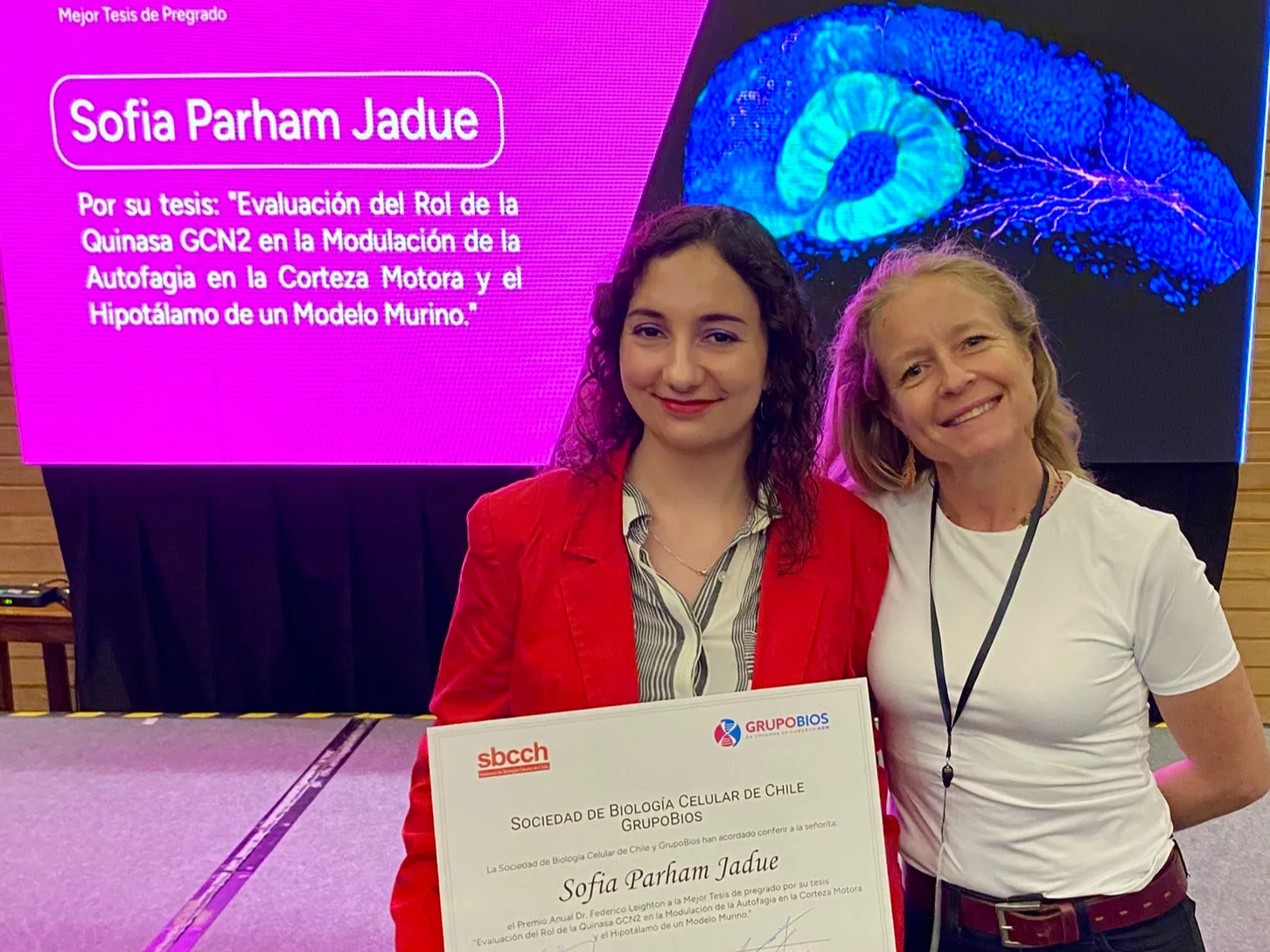
Sofía Parham Jadue, researcher at the Biology of Neurodegeneration Laboratory of the Centro Ciencia & Vida (FCV-USS) and biochemistry alumna from the Faculty of Chemical and Pharmaceutical Sciences of the Universidad de Chile, was recognized by the Chilean Society for Cell Biology with the Dr. Federico Leighton Award for the Best Undergraduate Thesis 2025, a distinction highlighting excellence in scientific research conducted in the country.
For Sofía, the recognition represents a personal and academic milestone.
“It is a tremendous source of pride to receive this award. It reinforces that my work, and the work we do in the laboratory, is on the right track, is robust, and worthy of recognition. It is an honor to belong to such a group,” she states.
A pioneering study on cellular adaptation and sex differences
Her thesis, titled “Evaluation of the Role of GCN2 Kinase in the Modulation of Autophagy in the Motor Cortex and Hypothalamus of a Murine Model,” explores an essential signaling pathway for cells to adapt to environmental changes, particularly amino acid scarcity.
The work focuses on GCN2, a key protein that acts as an amino acid sensor and allows cells to activate adaptation mechanisms in the face of nutritional deficits. The research was conducted in two brain regions—the motor cortex and the hypothalamus—and considered both male and female animals, revealing profound differences between the sexes.
“We discovered that males and females respond completely differently to a low-protein diet, and that these responses are mediated by GCN2. This had not been described before,” the researcher explains.
The metabolic measurements initially incorporated as controls—body weight, blood glucose, and motor function—ended up yielding unexpected and highly relevant results for understanding the role of this pathway in the central nervous system and in the organism as a whole.
The Faculty: a pillar in her scientific training
Regarding her years at the Faculty of Chemical and Pharmaceutical Sciences of the Universidad de Chile, where she earned her degree in Biochemistry, she notes that the training received was key to her development as a researcher. “The Faculty provided me with a very solid chemical and biological foundation, which has been fundamental in addressing the questions that arise in research and in the daily life of the laboratory,” she comments. The research work allowed for the development of her thesis to obtain her professional degree in biochemistry, work that was sponsored by Professor Alfonso Paredes of the Faculty of Chemical and Pharmaceutical Sciences of the Universidad de Chile, affiliated with the Department of Biochemistry and Molecular Biology.
“The Faculty has very good teachers. In particular, the classes by professors Daniela Seelenfreund and Valentina Parra were dazzling, and it was a privilege to have them as teachers. Furthermore, being able to participate in these instances with them was very inspiring for me. I also highlight Professor Alfonso Paredes, whose guidance in this process was of great help. He always showed a great willingness to help with any problem, and I am very grateful for that,” Sofía emphasized.
Born in Santiago and of Palestinian descent, Sofía explains that her decision to dedicate herself to science was born from the wonder of understanding how life works at the molecular level: “Biochemistry allows for the study of the very basis of life. I find it fascinating to have the possibility of knowing in the greatest detail how living beings function and delving into processes that are not yet fully understood. It is simply fascinating.”
A training marked by teamwork
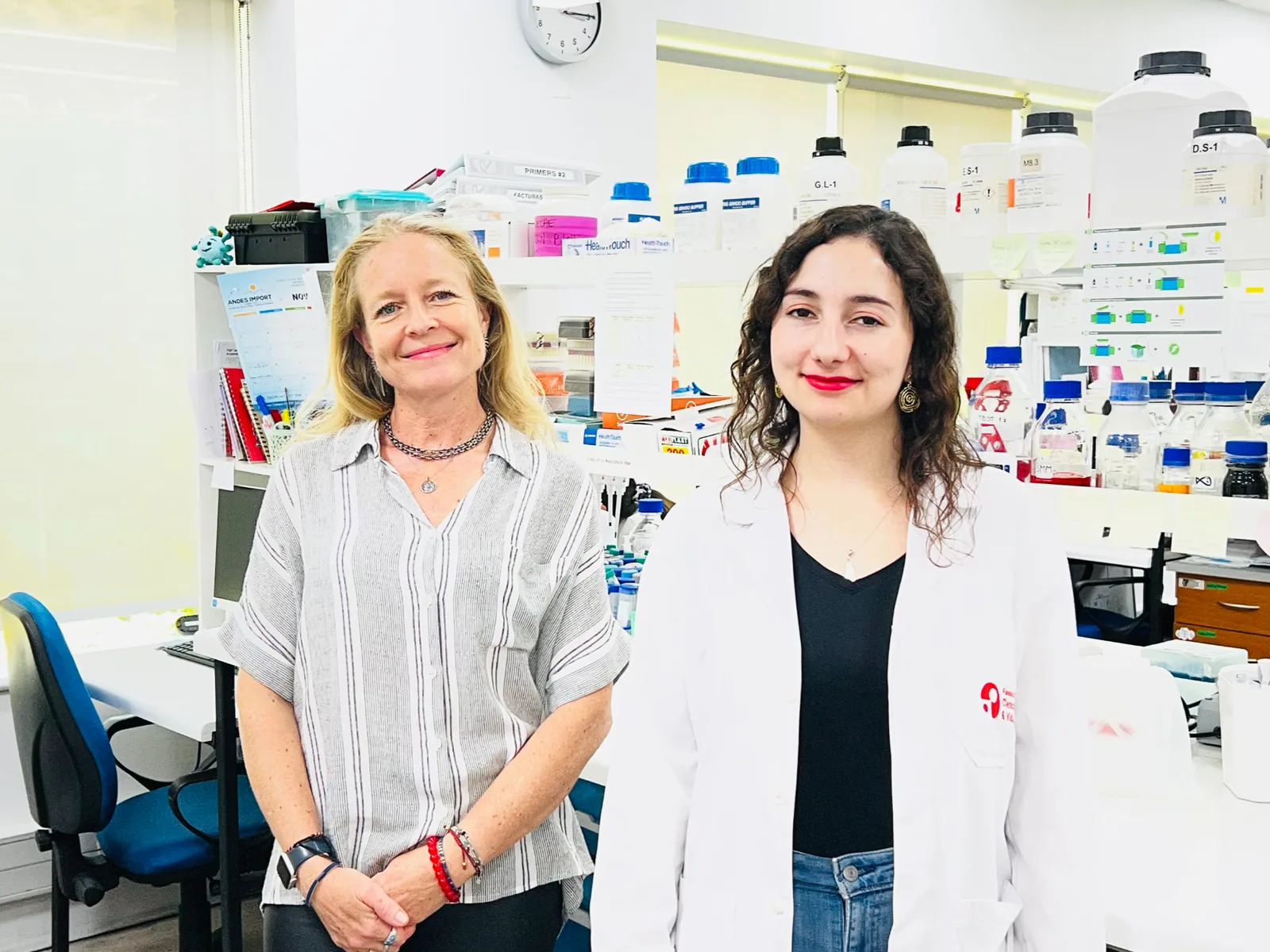
The project was developed in the Biology of Neurodegeneration Laboratory of the Centro Ciencia & Vida (FCV-USS) under the supervision of the Center's principal investigator and academic of the Faculty of Science of the Universidad San Sebastián, Dr. Soledad Matus Montero. The experience, Sofía says, has been deeply significant both academically and personally.
“I have been in this laboratory for three and a half years, and it has been very enriching. Working under the mentorship of Dr. Matus has been an honor, and I have learned a lot from her, both academically and personally. She is a great person. Additionally, the atmosphere in the Laboratory is excellent, and I have learned a great deal, especially from Marcela Escandón, who has been a great colleague and friend,” notes the young researcher from the basal center Centro Ciencia & Vida (FCV-USS).
Original text: Jorge Aliaga Sandoval, Journalist FaCiQyF Uchile .