
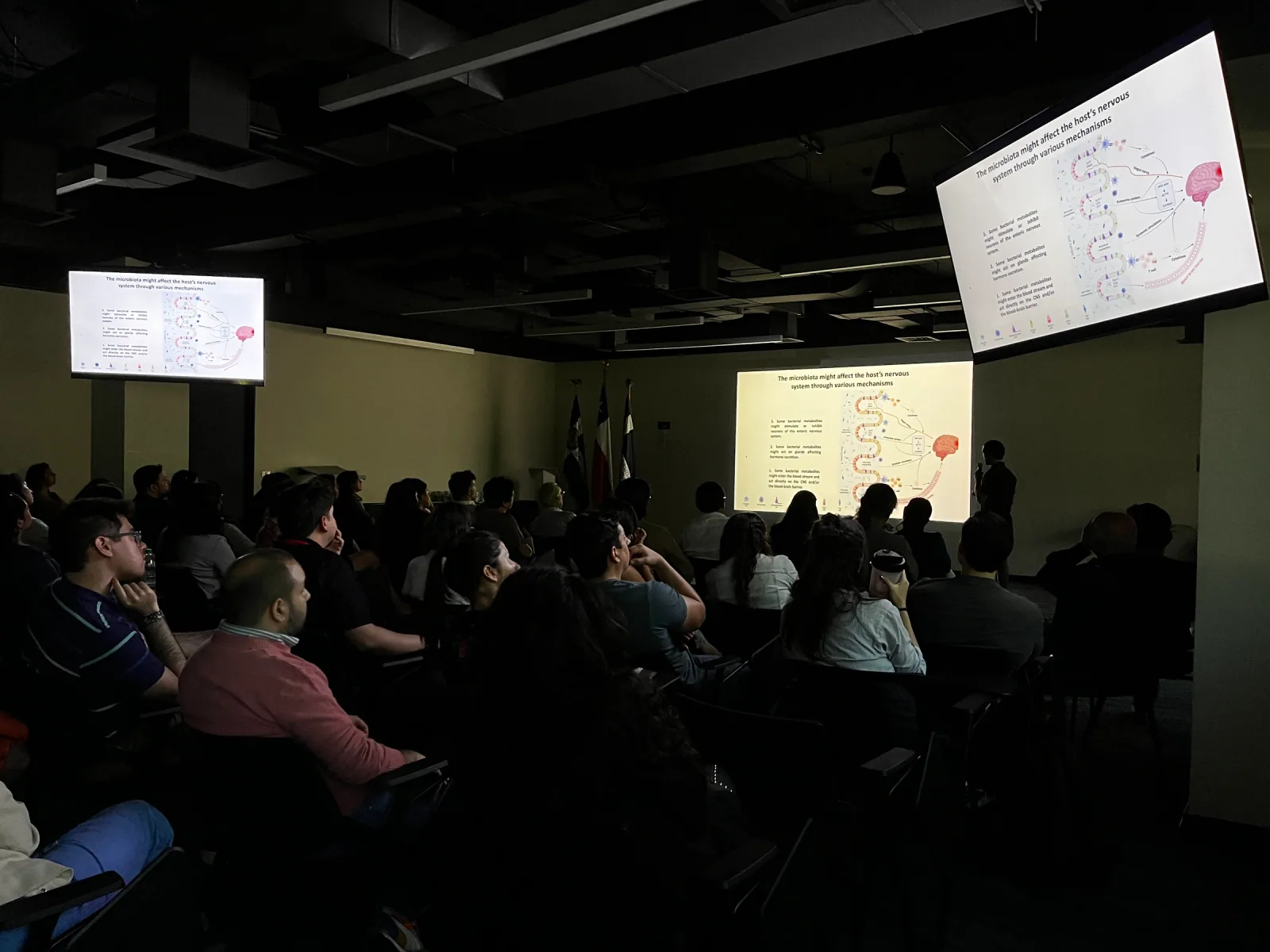
Dr. Rodrigo Pacheco, principal investigator at the Centro Basal Ciencia & Vida of Universidad Sebastián, presented the results of the research he leads with funding from the Agencia Nacional de Innovación y Desarrollo, ANID.
The director of the Laboratory of Neuroimmunology at the Centro Basal highlighted the teamwork that enabled the development of a modified T-cell therapy with the potential to curb inflammation and halt neurodegeneration at its origins.
This breakthrough and its patent demonstrate that national science is at the forefront of biomedicine.
The closing event of the FONDEF project ID22I10070, titled “T-cell engineering for a therapy against Parkinson's disease”, represents a significant advancement in Chilean biomedical research.
Led by Dr. Rodrigo Pacheco, principal investigator at the Centro Basal Ciencia & Vida and academic at Universidad San Sebastián, the project advanced the development of an autologous cell therapy that opens new hopes for the treatment of Parkinson's disease.
According to the presentation by Pacheco, a biochemist, PhD in Immunology, and director of the Laboratory of Neuroimmunology at the Centro Ciencia & Vida of USS, the results of the Fondef project propose an immunotherapy using regulatory T lymphocytes (Treg) modified with chimeric antigen receptors (CAR-Treg therapy). These genetically engineered receptors act specifically by recognizing a pathogenic protein associated with Parkinson's disease, stopping the inflammation that drives neurodegeneration in this pathology.
The therapy is distinguished by its ability to:
Halt the autoimmune inflammatory response that triggers the destruction of dopaminergic neurons in the substantia nigra, nerve cells involved in the regulation of voluntary movements.
Reduce neuroinflammation and significantly improve motor function in preclinical models of the disease.
The results obtained in the experimental stages of the project validate its efficacy and safety, thus consolidating a robust foundation for future clinical application.
Patented therapy
One of the major achievements of the research is the patent registered for the CAR-Treg therapy. This patent not only recognizes the originality of the therapeutic approach, but also ensures its intellectual protection, facilitating the projection toward new phases of development and eventual technology transfer for clinical applications.
The patenting process, supported by the Intellectual Property Directorate of the Centro Basal, highlights the multidisciplinary collaboration and rigorous scientific work behind the project. This step is key to attracting future funding and strategic partnerships that will allow progress toward clinical trials and, eventually, clinical use.
The culmination of this project not only represents a breakthrough in the understanding of Parkinson's, but also a major leap toward specific and personalized therapies, with an approach aimed at treating the underlying causes of the disease rather than its symptoms.
“This therapy has the potential to change the paradigm of Parkinson's treatment by focusing on halting the progression of the disease from its early stages,” highlighted Dr. Rodrigo Pacheco during the closing event.
The success of this initiative is the result of a collaborative effort among various institutions and researchers. Dr. Pacheco highlights the contribution of a highly qualified team of professionals, as well as the collaboration of Fundación Ciencia & Vida, Universidad San Sebastián, the Agencia Nacional de Investigación y Desarrollo (ANID), and the Michael J. Fox Foundation.
The closing of the FONDEF project ID22I10070 marks a crucial milestone in the development of new therapies for Parkinson's disease, consolidating a path that integrates science, innovation, and technology to improve patients' quality of life. The developed CAR-Treg therapy is an example of how high-impact research can generate transformative solutions and position our country as a relevant player in global biomedicine.