
The principal investigator of the Centro Ciencia & Vida of the Fundación Ciencia & Vida – USS will work on the design of new therapeutic peptides to inhibit fibrosis, a pathological process associated with multiple chronic diseases.
The principal investigator of the Centro Ciencia & Vida, of the Fundación Ciencia & Vida - USS, will work on the design of new therapeutic peptides to inhibit fibrosis, a pathological process associated with multiple chronic diseases.
Fibrosis is a condition that affects millions of people worldwide and is characterized by an abnormal accumulation of connective tissue that can seriously compromise the function of organs such as the lungs, liver, or kidneys.
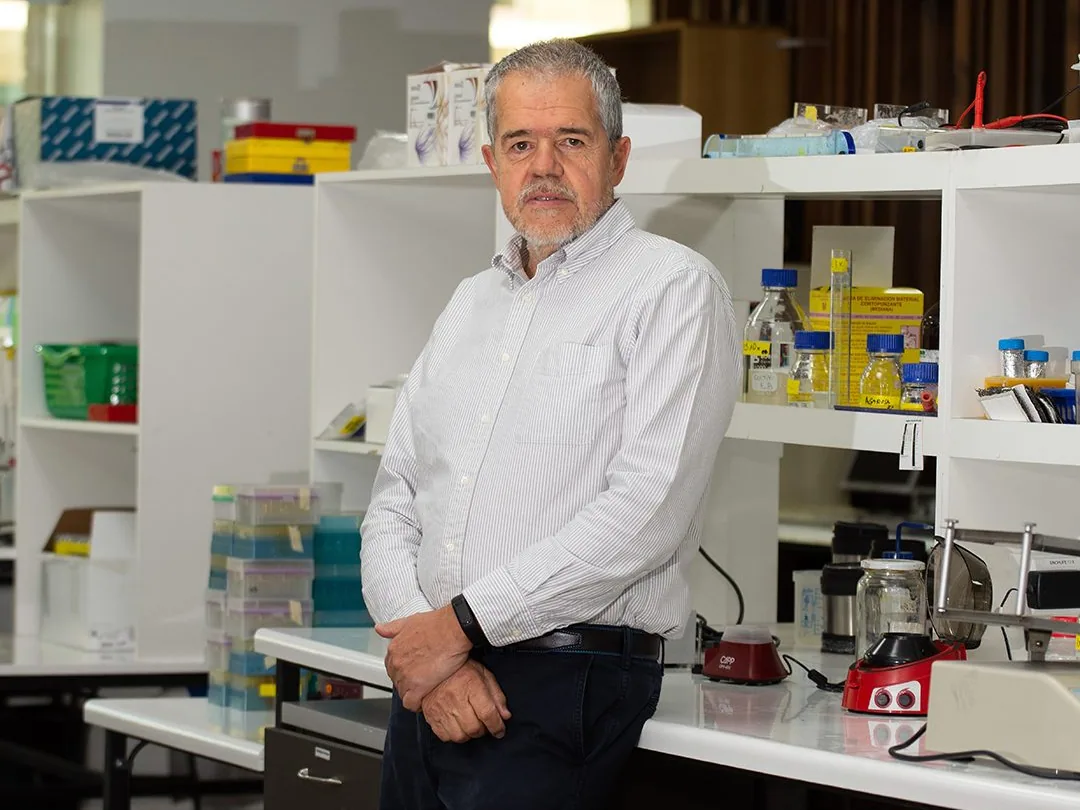
Faced with this problem, the laboratory led by Dr. Enrique Brandan, principal investigator of the Centro Ciencia & Vida and academic at the Universidad San Sebastián, has taken a decisive step by being awarded a new 2025 IDeA R&D Fund, granted by the Agencia Nacional de Investigación y Desarrollo (ANID).
The research titled “Novel approach for the treatment of fibrosis: development and evaluation of new inhibitory peptides of the connective tissue growth factor (CTGF)” seeks to develop and test new peptides that can block the action of CTGF, a key protein in the progression of fibrosis.
“Fibrosis appears in all chronic diseases of various origins. One can have pulmonary fibrosis, hepatic fibrosis, renal fibrosis, or muscular fibrosis,” explains Dr. Brandan, “therefore we believe that by specifically targeting a key factor in inducing fibrosis, CTGF, we will be able to combat its different manifestations and, of course, we will be able to test it in different models of fibrosis,” he adds.
The project is based on years of joint work, both from his laboratory and a team of researchers, all academics and students of the USS under his charge dedicated to the study of the molecular mechanisms of fibrosis, as well as support from the Business and Intellectual Property areas of the Fundación Ciencia & Vida - USS.
The initiative represents a commitment to achieving a more specific therapy that reduces the side effects of current treatments and offers new therapeutic possibilities.
“The peptides we are evaluating come from a previous observation that the profibrotic factor CTGF was inhibited by a specific protein. From that protein, we were able to produce, through biochemical assays and computational modeling, some potential peptides that inhibit this factor,” indicates the researcher.
The awarding of the 2025 IDeA R&D Fund will allow for the strengthening of the scientific team, access to new analysis technologies, and the establishment of strategic collaborations. Likewise, it reinforces the commitment of the Centro Ciencia & Vida of the Universidad San Sebastián to frontier research that can generate a real impact on people's health.
“What we hope to do is to be able to modify those peptides, modify the ability to interact with CTGF in such a way that they are more stable and stronger from an inhibition standpoint and with that, above all, be able to prevent the onset of fibrosis, which is known to be associated with these chronic diseases,” concludes Dr. Brandan.
From the Center, we congratulate Dr. Brandan and his team on this important achievement, which reflects the high level of science developed in Chile and its potential to face complex biomedical challenges.