

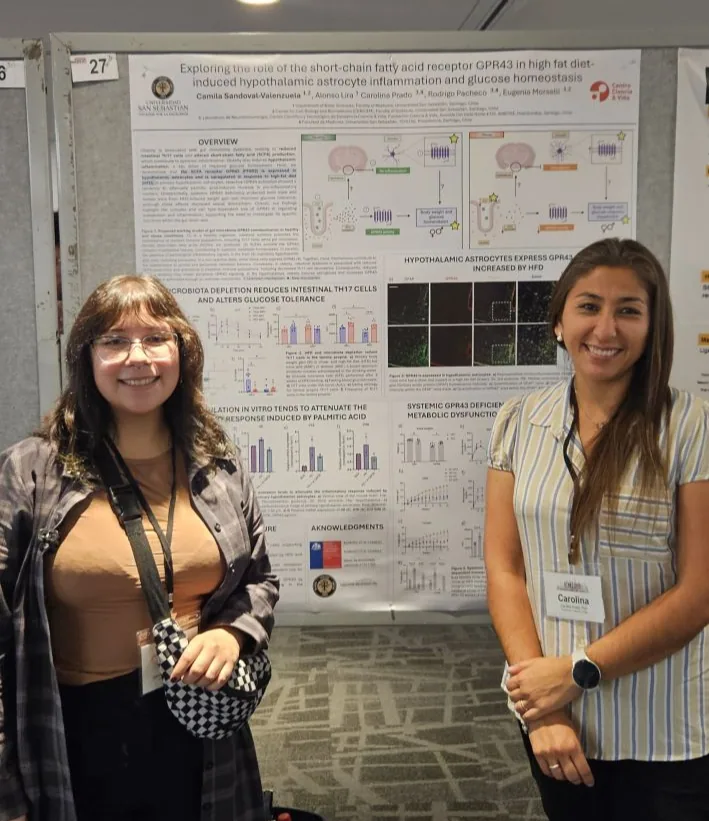
A team from Centro Ciencia & Vida presented evidence of this cell traffic at the world’s leading scientific congress on mucosal immunology, held this year in Canada.
Carolina Prado Terrazas, associate researcher at Centro Ciencia & Vida (FCV-USS) and academic at Universidad San Sebastián, led the Chilean delegation together with PhD student Camila Sandoval.
Immune cells that originate in the gut can travel to the brain and change their behaviour depending on the health of the intestinal mucosa. In animal models, these cells migrate from a healthy gut in an anti-inflammatory state, whereas in chronic intestinal inflammation they reach the central nervous system already reprogrammed towards a pro-inflammatory profile.
Carolina Prado, associate researcher at Centro Ciencia & Vida (FCV-USS) and academic at the Faculty of Medicine of Universidad San Sebastián, presented these results at the International Congress of Mucosal Immunology (ICMI2026), held this year in Canada. Every two years the meeting brings together the global scientific community specialising in mucosal immunity.
The congress rotates between North America, Europe and the rest of the world. The previous edition took place in Denmark and the next one is planned for Japan. Prado works in neuroimmunology, a field distinct from classical mucosal immunology, but her presence reflects the growing evidence on the role of the gut in autoimmune diseases of the central nervous system.
For years it was assumed that the digestive, nervous and immune systems worked independently. That premise changed with the consolidation of the gut–brain axis, the framework that explains how intestinal activity affects brain function. “Many years ago people believed the systems acted independently, the digestive, the nervous, the immune; now we know that all the systems interact with each other,” explains Dr. Prado.
A cellular map of the gut
The central finding of the research by Carolina Prado and her team describes how immune cells from the gut migrate to the central nervous system and change their behaviour depending on the bacteria present in the gut. The study, entitled “Microbiota-Dependent Licensing of Colonic T Cells for CNS Trafficking”, was presented in the session “Neuro-immune interactions”.
To trace this traffic, the team used experimental models that make it possible to follow the cells’ route precisely, since direct analysis of the human brain is not a viable option for this kind of study. The technique consists of labelling only the cells of intestinal origin with a specific colour, different from that of every other cell in the animal.
This labelling works as a biological tag that reveals the intestinal origin of each cell observed in the brain. “In the model we mark the gut cells with a colour that is completely different from the colour of all the other cells; if I then analyse the brain and find cells of that colour, it is because they came from the gut,” says Prado.
The procedure makes it possible to reconstruct not only the physical route of the cells but also the changes in their functional state. The experiments showed that in the mouse model of multiple sclerosis, changes in gut bacteria promote a change in behaviour that is, for the researcher, the most relevant result of the work.
“In this autoimmune disease, the immune cells of the gut go from being very anti-inflammatory cells, sitting there at rest, to being highly inflammatory cells that produce cytokines promoting this degeneration or inflammation in the central nervous system,” she says.
Complementary therapies
The disease model used in the research is multiple sclerosis, an autoimmune condition in which the immune system stops recognising the body’s own components and attacks them. This recognition error is common to other diseases with an autoimmune component, including Parkinson’s and Alzheimer’s.
Dr. Prado maintains that her team’s findings can be extrapolated to this group of diseases, although each requires its own assessment of the mechanisms and cells involved. “It is highly extrapolable, because in different diseases such as Parkinson’s, Alzheimer’s or multiple sclerosis, which is the focus of my research, this immune component has been linked to changes in the gut microbiota,” says the researcher.
Multiple sclerosis has no cure, so the researcher frames her work as a contribution to complementary therapies rather than a replacement for existing treatments. Her team studies in particular the mechanism by which gut metabolism influences the traffic of cells to the brain.
A previous study, cited by Dr. Prado in her presentation, showed that increasing dietary fibre intake – which acts much like a probiotic – modulates the intestinal immune system and reduces the number of relapses in patients with the disease.
This kind of intervention is clinically attractive because it requires no invasive procedures. “We are not going to set aside the current therapies; rather, we propose that understanding what is happening in the gut can help complement the therapies that already exist,” the scientist adds.
Chilean science at ICMI2026
The Chilean delegation at ICMI2026 consisted of three people, among them Camila Sandoval, a PhD student in Cell Biology and Biomedicine at Universidad San Sebastián and the only student present at this year’s edition. Dr. Prado encouraged her to apply and take part. For Prado, the difference from the previous edition – held in Denmark, attended by two Chilean lab heads – marks a milestone for the field.
“This year I am very happy because we went with a PhD student; it is great for her visibility and for her to be in contact with top-level researchers,” she says.
The researcher sees the experience as a way to offset a structural limitation of the Chilean science system: restricted access to cutting-edge technology. Congresses such as ICMI2026, she says, make it possible to build networks that later turn into concrete collaborations. These alliances can mean sending students to laboratories abroad or gaining access to technology not available in Chile, the USS academic stresses.
The specialist emphasises that fostering the early training of young women scientists is key, because opportunities to present results internationally tend to be concentrated in the later stages of a career. “The goal is to encourage students to go out and make their work visible from the start, before it is too late to build a global presence,” she concludes.
Text by Luis Francisco Sandoval, S&M Comunicaciones agency.